
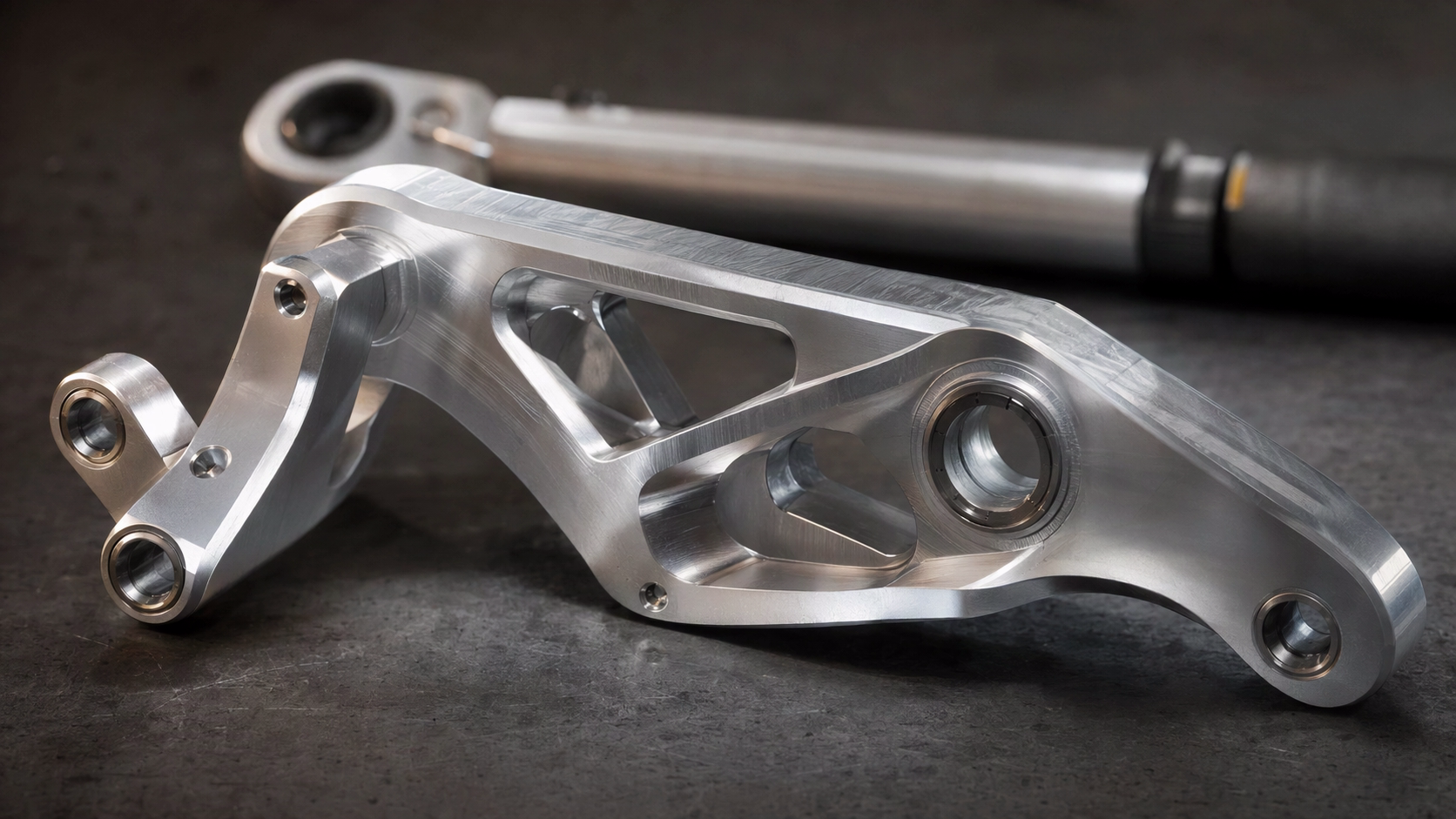
Key takeaway: Specify 7075 when the part must carry a real load at minimum weight, and nowhere else. It delivers close to twice the yield strength of 6061 at almost the same weight, but it costs more, corrodes easier, cannot be fusion welded, and does nothing for a stiffness problem. Most designs that “need 7075” actually need a rib.
Choosing 7075 aluminum machining is a trade, not an upgrade. You buy strength, and you pay for it in corrosion protection, weldability, tooling wear, material cost and lead time. The useful question is therefore not “is 7075 stronger” — it is — but whether the specific load in your part is the kind that only 7075 can carry.
This guide covers how the alloy gets its strength, where high strength aluminum CNC parts genuinely earn their place, the four situations where specifying it is a mistake, and what changes at the machine and in service. Temper selection — T6 versus T651 versus the over-aged conditions — is treated in a separate companion piece and is not repeated here, because it is a different decision with its own failure mode.
1. Quick answer: when 7075 is the right call

Find the requirement that describes your part. The row you land on is the specification you should write.
1-1. Decide it by the requirement, not the material
| The binding requirement | Specify | Why not the alternative |
|---|---|---|
| Yield strength at minimum mass, in a controlled environment | 7075 plate or forging | 6061 needs roughly twice the section to carry the same load, and then loses the weight advantage |
| General structural part with spare mass budget | 6061 | Cheaper, stocked wider, better corrosion behavior, weldable, and anodizes nicer |
| Salt spray, immersion or chemical exposure | 5052, or 6061 with a coating plan | 7075 without protection corrodes faster than either, and the protection adds cost back |
| Welded frame or assembly | 6061 or 5052 | 7075 is not treated as fusion-weldable; the joint is the weak point before the load is |
| Deflection is the complaint, not failure | Any alloy, plus geometry | All aluminum alloys share the same stiffness; a stronger alloy does not bend less |
| Sustained tensile load in a humid or contaminated environment | 7075 in an over-aged condition | Peak-strength conditions are the most vulnerable to stress-corrosion cracking |
1-2. What this guide helps you avoid
- Paying a material premium and a longer lead time for a part that failed on stiffness, where 7075 changes nothing.
- Discovering at the weld review that the assembly cannot be welded in the alloy you specified.
- A first-article rejection caused by stress relief after machining, which is a temper and process question, not a strength question.
- Corrosion under a coating in a marine application because the alloy was chosen for strength and nothing was specified for protection.
1-3. The three questions that decide
- Does the part yield, buckle or fatigue? Yielding is a strength problem; buckling is a stiffness problem; fatigue sits between them.
- Is mass the constraint, or is it just nice to have? 7075 pays off when grams are bought with money.
- What does the environment do over five years? Wet, salty or chemically loaded service changes the answer more than any strength number.
2. Where the strength comes from

7075 is not magic metal. It is an aluminum-zinc-magnesium-copper alloy with a small chromium addition, and its strength is manufactured by heat treatment rather than bought entirely in the alloying.
2-1. The additions and what each one does
Zinc and magnesium are the main strengthening pair; copper improves the response to heat treatment and raises strength further, at the cost of corrosion resistance; chromium is a small addition that refines the grain structure. The Teal Sheets published by the Aluminum Association put zinc at 5.1 to 6.1 percent by weight, with 2.1 to 2.9 percent magnesium, 1.2 to 2.0 percent copper and 0.18 to 0.28 percent chromium. Zinc is not a deliberate addition in 6xxx alloys, and the total strengthening addition here is several times what 6061 carries.
2-2. How heat treatment turns that into strength
The metal is heated so the alloying elements dissolve into the aluminum, quenched so they are trapped there, then held at moderate temperature so they come out of solution as extremely fine particles. Those particles are what stop dislocations moving through the crystal, and stopping dislocations is what strength is, physically. The same chemistry in the soft annealed condition is a structurally unimpressive metal.
2-3. The forms you can actually buy
For machined parts the practical options are plate, thick sheet, extruded shapes and drop forgings. Plate dominates for pocketed parts; AMS 4045 covers 7075 sheet and plate from 0.008 to 4.000 in (0.20 to 101.6 mm) in thickness. Forgings are chosen when fiber flow and fatigue behavior matter more than machining time, such as loaded lugs and fittings. Extruded 7075 exists but is less common than 6061 and 6063 extrusions, which limits how much of a design can lean on it.
2-4. The cleaner sibling: 7475
7475 is essentially a tighter-control version of the same chemistry, with impurities reduced to improve toughness and resistance to crack growth. It is specified when the design is damage-tolerant rather than simply strong, and it is harder to source. If a supplier offers it as a casual substitution, that is a specification conversation, not a purchasing convenience.
3. Strength in context: what it beats and what it does not

Strength numbers only mean something next to the alternatives a designer would otherwise consider.
3-1. Against 6061
Typical published values put the yield strength of 7075 in the T6 condition near 73 ksi (503 MPa), close to twice the 40 ksi (276 MPa) of 6061-T6. The specification that turns those figures into guaranteed minimums, AMS 4045, is what belongs on the drawing. That is the headline, and it is real. The density penalty is small, roughly four percent, so strength per weight improves almost as much as strength itself.
3-2. Against mild steel
Here is the fact that surprises buyers: a common structural mild steel has a yield strength in the same band as 6061-T6, and well below 7075. So 7075 can carry more load than that steel while weighing about a third as much. That combination is the entire reason the alloy exists commercially.
3-3. Against titanium
Titanium alloys used in machining go considerably higher in strength than 7075, but at roughly 1.6 times the density and a much higher cost per part, driven by slow machining and tooling consumption. The usual pattern is titanium at the highest-loaded interfaces and 7075 for the rest of the structure.
3-4. The number that does not move: stiffness
Elastic modulus for 7075 sits in the same place as every other aluminum alloy, around 70 GPa, which is about one third of steel. A 7075 bracket and a 6061 bracket of identical shape deflect identically. If the design complaint is deflection, the fix is geometry: add a rib, deepen a section, move a wall. This is the single most common misunderstanding in aluminum part reviews, and it is worth checking before the material is bought. Our guide to aluminum CNC machining materials walks through that trade across the alloy families, and the companion article on 6061-T6 CNC machining covers the default grade most designs should be tested against first.
4. Where high strength aluminum CNC parts are used
IMAGE NEEDED — real photograph. This section needs a genuine shop photograph. AI generation produced technically impossible geometry for this scene (square internal pocket corners that no round cutting tool can produce, or instruments shown in incorrect use), so no illustration is placed here. Suggested subject is named below.
Suggested subject: a set of 7075 aerospace or motorsport hardware on a bench, ideally the actual parts your shop has machined, with recognisable and manufacturable geometry.
The pattern across every legitimate application is the same: a real load path, a mass budget that matters, and an environment the designer can control.
4-1. Aircraft structure and fittings
Lugs, frames, rib fittings and loaded brackets. This is the origin of the alloy, and it is where the specification discipline is strictest: the engineering standard names the alloy, the temper and the treatment, and substitution is not a purchasing decision.
4-2. Racing and motorsport hardware
Steering uprights, hub carriers, pedal boxes, suspension brackets and gearbox housings. Loads are high, grams are expensive, and the parts are machined in low quantities, which suits a high-strength alloy bought as plate. Corrosion protection and crack inspection matter more here than in most industrial use.
4-3. Robotics and automated handling
End-effector plates, arm sections and gripper bodies. The argument is not static strength but moving mass: a lighter arm accelerates faster, settles sooner and needs a smaller motor, so the whole system gets cheaper even though the part gets dearer.
4-4. Tooling and fixtures
Location fixtures, drill plates and check fixtures where a thin, light plate must not sag under its own weight plus the parts resting on it. Aluminum is chosen over steel for handling weight, and 7075 when the section has to stay thin.
4-5. Sporting goods and outdoor equipment
Bicycle components, climbing and mountaineering hardware, fishing reel bodies and high-load frames. Strength-to-weight sells the product, which is exactly the case the alloy was built for — provided the coating system is designed for weather.
5. Four cases where 7075 is the wrong answer

These are the calls that cost the most, because they usually look like quality decisions at the time.
5-1. The problem is deflection
Stiffness is set by modulus and geometry. Modulus does not change between aluminum alloys, so paying for 7075 to stop a part flexing buys nothing. Add material where the bending moment is, not where the marketing brochure is.
5-2. The assembly gets welded
7075 is not treated as fusion-weldable; hot cracking during welding is a real risk, and the heat destroys the temper locally regardless. If the design will be welded, the alloy conversation should start again with 6061 or 5052, before the drawing is released.
5-3. The environment is wet, salty or chemical
The copper and zinc content that gives the strength also makes the alloy more vulnerable than 6061 or 5052, and it is more sensitive to galvanic attack when bolted to steel. Unprotected 7075 in coastal service is a maintenance schedule, not a design.
5-4. The part is over-engineered
Run the load case honestly. A great many “high strength” calls survive contact with a 6061 calculation that has a rib added, and the difference in material cost, stock availability and machining time is worth real money at volume. Specify 7075 because a calculation demands it, not because the number looks safe.
6. What changes at the machine
IMAGE NEEDED — real photograph. This section needs a genuine shop photograph. AI generation produced technically impossible geometry for this scene (square internal pocket corners that no round cutting tool can produce, or instruments shown in incorrect use), so no illustration is placed here. Suggested subject is named below.
Suggested subject: a rigid tooling setup on a machine table — short tool, visible clamps and parallels — mid-cut with real chips.
7075 is machinable and produces good surfaces, but in 7075 aluminum machining the shop’s plan changes in four places compared with 6061.
6-1. Tooling and wear
The alloy is firmer and more abrasive on the cutting edge, so tool life per insert drops and rigid, short tooling matters more. Boring and deep-pocket work benefits from the stiffest holder the geometry allows, because deflection shows up as both size error and taper.
6-2. Chips and built-up edge
Chip control is reasonable, but the zinc-rich alloy can still weld to an edge that is being run too lightly for its geometry. A torn pocket floor or a bore that drifts small is the usual symptom. Increase feed per tooth before reducing speed.
6-3. Stress relief during material removal
Because parts in this alloy are typically milled from thick plate, the amount of stress released during cutting is larger than in a light 6061 bracket. Roughing and finishing are separated, and the choice of mill temper becomes the deciding factor. That subject has its own article — the companion guide on 7075-T6 versus T651 — and it is the one to read before writing the material line on a drawing.
6-4. Appearance after finishing
Anodized 7075 comes out dull and gray rather than bright, because of the zinc, and dyed colors are muted. If the part is seen by a customer, that is a design input, not a cosmetic surprise. Hard coat still performs well where wear is the concern.
6-5. Dust handling
A copper- and zinc-bearing alloy should be treated as a controlled particulate at the machine: extraction at source, wet or vacuum cleanup rather than air blowdown, and handling per the applicable safety data sheet and local rules.
7. Protecting 7075 in service

Strength you cannot use is not strength. Three protection decisions cover most designs.
7-1. Coating choice
Convertive coatings give light protection and keep some surface conductivity; anodic films give wear resistance and moderate corrosion protection; organic coatings such as powder give the best barrier on complex assemblies. Choose the protection for the environment, then confirm the coating thickness allowance against your critical dimensions.
7-2. Galvanic isolation
Where 7075 is bolted to steel, in a wet joint, the aluminum is the metal that suffers. Isolate with non-conductive washers and sleeves, avoid crevice traps for standing electrolyte, and coat the joint rather than only the visible faces.
7-3. Stress-corrosion cracking
High-strength aluminum under sustained tensile stress in a corrosive environment can crack at stresses far below the yield figure. The standard engineering answers are to reduce the residual and applied stress, to choose an over-aged temper, or to change the alloy. Residual stress is the cheapest of the three to control, which is why the mill temper designation belongs on the drawing.
8. Specifying and buying checklist
IMAGE NEEDED — real photograph. This section needs a genuine shop photograph. AI generation produced technically impossible geometry for this scene (square internal pocket corners that no round cutting tool can produce, or instruments shown in incorrect use), so no illustration is placed here. Suggested subject is named below.
Suggested subject: a completed part beside its inspection report and material certificate, identifiers redacted.
Seven lines to check before 7075 aluminum machining is quoted, and before the plate is ordered. Each one is cheap on paper and expensive after machining.
8-1. On the drawing
- Alloy and full temper written out, not just “7075”.
- Tolerances tight only where the function demands them, with the measurement method stated.
- Datum scheme defined so machining and inspection share the same references, with geometric callouts following ASME Y14.5.
- Coating specified with its dimensional allowance, and masked areas marked.
8-2. With the material and the supplier
- Mill certificate requested and matched to the delivered lot; heat treat, anodizing and coating come from Nadcap-accredited shops, with the certificates in the pack.
- Weldability and environment re-checked against the alloy choice before release.
- First article reported feature by feature, including geometric callouts, before the run continues.
9. Conclusion: buy 7075 for the load, not for the number
9-1. Confirm the failure mode first
Yielding justifies 7075. Buckling and deflection do not — those are geometry, and geometry is free.
9-2. Check the environment before the strength
Salt, immersion and mixed-metal joints can disqualify the strongest option in the catalog.
9-3. Then check the joining method
If the design is welded, the alloy conversation belongs back at 6061 or 5052.
9-4. Write the full specification and protect it
Alloy plus temper on the drawing, certificate against the lot, coating with its allowance, and isolation where dissimilar metals meet.

Frequently asked questions about 7075 aluminum machining
Is 7075 stronger than steel?
Stronger than common mild structural steel in yield terms, yes, at about one third of the weight. It is not stronger than alloy or tool steels, which sit well above it. The comparison that matters is strength per unit mass, and there 7075 is genuinely competitive with much cheaper steels.
Why not use 7075 for every machined part?
Because it costs more per kilogram, is stocked in fewer sizes, wears tooling faster, corrodes more easily, cannot be fusion welded and anodizes to a dull gray. For a part that 6061 clears with a rib, all of those disadvantages and none of the benefit.
Can 7075 aluminum parts be welded?
Not by conventional fusion welding in design practice. Hot cracking is a real risk and the heat destroys the temper locally. If a joint must be made, the usual answers are mechanical fastening, adhesive bonding, or redesigning the assembly in a weldable alloy.
Does 7075 machine slower than 6061?
Somewhat, and mostly through tooling rather than raw speed. The alloy is firmer and more abrasive on the cutting edge, so inserts and cutters are consumed faster, and rigid short tooling matters more on deep features. Expect a modest cycle and tooling penalty, not a dramatic one.
What is the best aluminum alloy for lightweight high-load parts?
For machined parts, 7075 in a stress-relieved plate condition is the practical ceiling in common aluminum. Above that you leave aluminum for titanium, which is stronger but heavier, far more expensive to machine, and usually reserved for the highest-loaded interfaces.
Should I worry about corrosion on a 7075 bracket used indoors?
Indoor, dry service with no dissimilar-metal contact is the case where 7075 needs the least protection, and a clear anodic film or conversion coating is usually enough. The problems start with standing moisture, salt, and steel fasteners in a wet joint.
Glossary
- Yield strength — the stress at which a metal begins to deform permanently.
- Elastic modulus — stiffness. About 70 GPa for all aluminum alloys, roughly one third of steel.
- Drop forging — a shaped blank produced by forging rather than machining from plate, with continuous grain flow.
- Stress-corrosion cracking — cracking caused by the combination of tensile stress and a corrosive environment, below the yield stress.
- Galvanic corrosion — accelerated attack of the less noble metal when electrically coupled to a more noble one in an electrolyte.
- Over-aged temper — a heat treatment condition traded down in peak strength for better crack resistance.
- Mill certificate — the document reporting tested properties for the delivered lot.
References
- The Aluminum Association. Teal Sheets: International Alloy Designations and Chemical Composition Limits for Wrought Aluminum and Wrought Aluminum Alloys. Composition limits quoted in section 2-1. (aluminum.org/teal-sheets)
- The Aluminum Association. Aluminum Standards and Data, together with ANSI H35.1 alloy and temper designation systems. (aluminum.org)
- SAE International. AMS 4045 — Aluminum Alloy Sheet and Plate, 7075 (-T6 sheet, -T651 plate), Solution and Precipitation Heat Treated. Thickness range and minimum properties. (sae.org — AMS 4045)
- ASTM International. B209/B209M — Aluminum and Aluminum-Alloy Sheet and Plate. (astm.org)
- ASME. Y14.5-2018 — Dimensioning and Tolerancing. Datum reference frames and geometric controls. (asme.org — Y14.5)
- Performance Review Institute. Nadcap special process accreditation for heat treating and surface finishing. (p-r-i.org)

Leave a Reply