
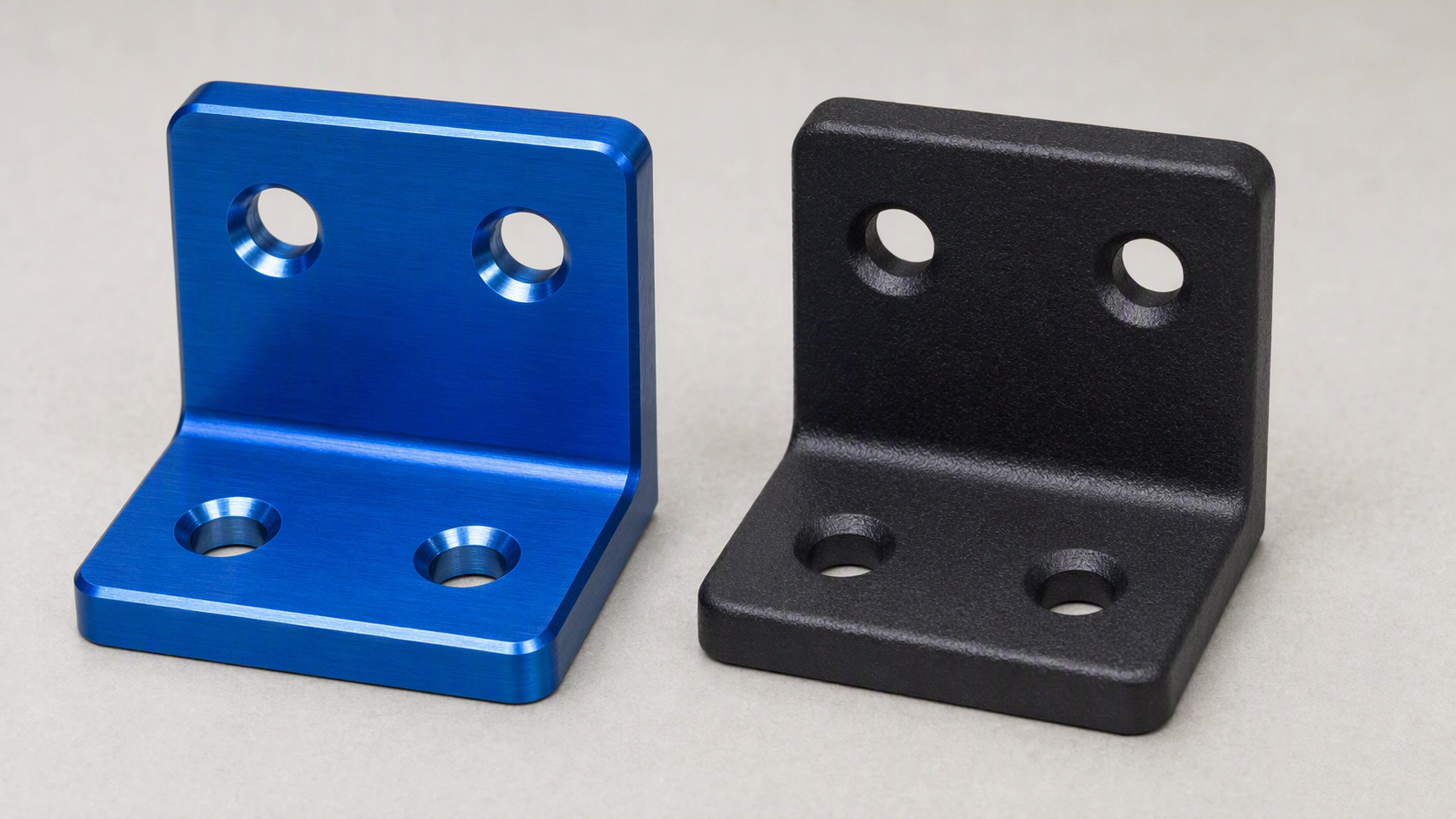
Key takeaway: Anodizing turns the aluminum surface into a hard, integral oxide that cannot peel. Powder coating lays a thick plastic film over the surface that hides more and protects edges better. Choose by function: wear and dimension control point to anodizing; coverage, color and cost on large panels point to powder.
Every machined aluminum part eventually meets a finish decision. The two candidates that appear on almost every quotation request are anodizing vs powder coating. They look similar on a sample card and behave very differently on the part. One is a conversion coating that grows out of the metal. The other is a paint system that sits on top of it.
That single difference explains nearly every downstream consequence: how much the part changes size, whether the finish can chip, how sharp corners are covered, whether the surface still conducts, and what happens when a part must be repaired. This paper compares the two in nine practical dimensions, then shows how to write the requirement on a drawing so the finish does not surprise you.
What anodizing and powder coating actually are
Anodizing is an electrochemical process. The part becomes the anode in an acid bath. Current grows a layer of aluminum oxide from the surface of the metal itself. The layer is porous, so it is dyed if color is wanted, then sealed in hot water or a nickel-fluoride seal to close the pores. Because the oxide is the metal converted, not a coating applied, it has no interface that can lift. Roughly half the total build grows above the original surface and half below it.
Type II is the standard sulfuric process, normally 5 to 25 micrometers. Type III, hard coat or thin hard anodize, is grown thicker and colder, commonly 25 to 50 micrometers or more, and it is chosen for wear surfaces.
Powder coating is a dry finishing process. A electrostatic gun charges a fine resin powder, which sticks to a grounded part. The part then goes through an oven, where the powder melts, flows and cures into a continuous plastic film. Typical film build is 50 to 130 micrometers, and textured finishes go thicker.

The practical divide is this. Anodize is thin, hard, integral and honest about the surface underneath. Powder is thick, tough in a different way, forgiving of the surface underneath, and it covers geometry that anodize cannot reach evenly.
Nine differences that decide the finish
| Criterion | Anodizing (Type II / Type III) | Powder coating |
|---|---|---|
| How it bonds | Integral oxide grown from the substrate; no interface to peel | Mechanical and chemical adhesion to a prepared surface; can chip if undertrained |
| Film build on one surface | About half of total build, so 3 to 25 micrometers (Type II) or 12 to 25 plus (Type III) | Full thickness, typically 50 to 130 micrometers |
| Hardness and wear | Very hard, especially Type III; excellent abrasion resistance, low lubricity | Tough against impact and flex, but scratches and chips more easily at edges |
| Corrosion resistance | Good, and unaffected by UV; thin Type II is a modest barrier | Excellent barrier when the film is continuous; pinholes are the failure mode |
| Color and gloss range | Clear, black, and a limited dye palette; metallic look is retained | Any color, gloss from flat to high, plus textures and hammered effects |
| Surface defect hiding | None. It reveals scratches, tool marks and extrusion lines | Good. A medium texture hides minor blemishes |
| Electrical conductivity | Insulating except at very thin clear coatings; mask grounding areas | Insulating; mask all grounding, bonding and RF areas |
| Heat and UV | Oxide is stable; dyes can fade in strong sun if not UV-stable | Resin can chalk or discolor; fluoropolymer systems resist this far better |
| Repairability | Poor. Repair usually means stripping and re-anodizing, which grows size again | Good. Local touch-up and re-spray are practical |

When to choose anodizing
Pick anodizing when the part is aluminum and one of these is true.
- Dimensions are tight. A few micrometers of growth is easier to plan than a hundred micrometers of film.
- The surface rubs, slides or is handled constantly. Hard coat resists abrasion far better than any paint film.
- The look of the metal should stay visible. Clear and light anodize keeps the machined or brushed appearance; powder buries it.
- The part cannot have a coating on certain faces. Anodize can be masked locally with wax or tape, and unmasked areas can be re-tapped or re-machined after the process.
- The part will live in sunlight or high heat. The oxide itself does not degrade in UV.
Alloy matters here. 6061 anodizes cleanly to bright clear or a soft blue-grey. 6063 gives the best appearance. 7075 turns a dull grey because of its zinc content, and castings such as A356 can anodize sandy or mottled because of their silicon. If the color is the point, choose the alloy before you choose the finish. Our guide to magnetic and non-magnetic metals explains why aluminum responds to neither a magnet nor a magnetic chuck during processing.
When to choose powder coating
- The part is large, flat or an assembly. Enclosures, frames, panels and brackets are cheaper to coat than to anodize at that size.
- You need an exact brand color. Powder can be matched to a RAL or Pantone reference far more reliably than a dye bath.
- The surface has cosmetic history. Welds, repairs, minor scratches and extrusion lines disappear under a textured film.
- Edges need barrier protection. A thick film bridges a sharp edge; a thin oxide does not.
- Chemical exposure is the main threat. A continuous thick film is a better barrier against cleaners and salt than a thin anodic layer.
Two cautions. First, powder needs a clean, properly prepared surface, and it cannot be applied over an existing anodize without mechanical preparation. Second, a thick film on a machined datum face changes fit. If a face must stay true, mask it or leave it uncoated and say so on the drawing.

Dimensions, masking and tolerance drift
This is where finish decisions turn into rejected lots. Both processes change size, in different ways.
Anodizing grows evenly where current flows. Sharp corners and edges carry higher current density, so they build thicker than flat faces, while deep recesses and internal bores build thin or not at all. Threads, dowel bores and press-fit seats must be masked before the bath or cut clean afterward. If the drawing calls a thread to be gauged, the safest note is to machine and gauge after anodizing.
Powder coating wraps the outside and pulls back from edges. During cure the film flows and thins on sharp edges, which is exactly where chipping starts. Deep internal corners can receive little powder at all because of the Faraday cage effect, unless the coater uses shields or a second pass.
| Feature | Anodizing | Powder coating |
|---|---|---|
| Threaded hole | Mask, or tap after the process | Mask with a plug, or tap after cure |
| Press-fit bore | Machine after, or allow for growth | Machine after; growth is larger |
| Machined datum face | Usually acceptable if flatness is generous | Avoid coating; mask and leave bare |
| Grounding or bonding pad | Mask and require bare surface | Mask and require bare surface |
| Outside diameter held to fit | Allow half the total build | Allow the full film thickness |
| Deep pocket or internal corner | Thin or no coverage; consider a second dip | Thin coverage; ask the coater about shielding |
Ask one question early and it saves a lot of scrap: which dimensions apply before the finish and which apply after? That sentence belongs on the drawing, not in an email.
Appearance, color matching and durability
Color is a batch property in both systems. Alloy lot, temper, mill direction, surface preparation and bath age all shift the result. A black anodized 6061 bracket and a black anodized cast bracket will not match each other, and two powder lots from different days can drift slightly in gloss. The fix is procedural, not technical: approve a physical sample, keep it in the file, and order the finish quantity in as few lots as practical.
Preparation determines appearance more than the coating does. Bead blast before anodize gives a uniform matte look but also records flow lines in the surface. Brushing before clear anodize produces a decorative grain. If you want a specific look, state it and require a first article photograph.
On durability, the failure modes differ. Anodize does not peel; it wears, and it can be stained or scratched through the seal. Powder does not wear through easily; it chips at edges, and it can lift if the surface was contaminated before application. A part that is dropped is a powder problem. A part that is rubbed daily is an anodize advantage.
How to inspect and measure the finish
Specify what will be verified, and with what instrument.
- Coating thickness. On aluminum, use an eddy-current gauge. A magnetic gauge only reads non-conductive coatings on magnetic substrates, so it will not measure either finish on aluminum. This is a common and expensive mistake in receiving inspection.
- Adhesion and integrity. For powder, a cross-cut or pull-off test on a witness panel. For anodize, a weight gain test on a witness or a sealed-surface test such as the dye bleed evaluation.
- Corrosion performance. Salt spray per ASTM B117 is the common reference. Specify the exposure hours your product actually needs, and require the test report from the coater rather than a general claim.
- Appearance. Compare against the approved sample under defined lighting, and check masked areas for bleed or missed coverage.
- Dimensions after finish. Re-measure the features the drawing flags as post-finish, on the same datum scheme used before coating.
First article practice is the same as for machining. The report should list every characteristic, the actual value, and the gauge used, which is the format defined by AS9102 in aerospace work. Our article on process planning and final accuracy covers the inspection side in more depth.
Cost and lead time
Anodizing is usually priced by part surface area and by batch, with Type III costing more than Type II because the cycle is longer and colder. Masking is labor, so a part with six masked features costs more than a part with none. Powder coating is priced per part or per square meter, and it is generally cheaper on large flat geometry. Racking, pre-heat, color change and minimum batch charges are where small lots get expensive.
Lead time follows the same logic. Both are batch processes with a queue. A color change on a powder line costs more time than a clear anodize run. If you need two colors, ask whether they can be scheduled in the same week.
How to specify it on the drawing
A finish note that prevents disputes contains five elements. Write them once, on the drawing, not in an email.
- Process and type. For example, “Anodize, Type II, Class 1” or “Powder coat, TGIC-free polyester, 60 to 90 micrometers.”
- Color and gloss. A RAL or Pantone reference, a gloss value, and a statement that a physical sample governs.
- Surface preparation. Bead blast media and grit, brushed direction, or chem film undercoat where adhesion matters.
- Masking. A marked view showing which features must remain bare, with the reason: grounding, fit, thread gauging.
- Inspection requirement. Thickness method, adhesion test, salt spray hours if required, and whether a first article report is delivered.
Where the choice is genuinely open, write both options and let the shop advise. A supplier who tells you that your clear anodize on a cast part will look mottled is doing you a favor before the order, which is the cheapest possible intervention.
Frequently asked questions
Can you powder coat over anodized aluminum?
Not reliably. Adhesion to a sealed anodic layer is inconsistent. The usual route is mechanical abrasion of the area, then coating, and the result still will not match a coating applied to bare metal. Specify one finish per surface.
Which finish is more durable outdoors?
Both survive outdoors well. Anodize will not peel or chalk, but dyed color can fade if the dye is not UV rated. Powder offers any color and stronger barrier protection, but can chalk over long exposure unless a fluoropolymer or high-quality polyester system is used.
Does anodizing change part size?
Yes. Roughly half of the total coating growth sits above the original surface. Type II moves a few micrometers, hard coat moves far more, and edges move more than flat faces because of current density.
Can I get a tight tolerance and a finish on the same face?
You can, if you plan the order of operations. Machine to size, mask the feature, finish, then unmask. Or finish first and take a light cleanup cut. Both approaches cost money, and both are cheaper than a rejected lot.
Which is cheaper, anodizing or powder coating?
On small machined parts, comparable and often cheaper to anodize clear. On large panels and enclosures, powder is usually cheaper. Masking labor is the variable that flips the answer most often.
Glossary
- Type II — standard sulfuric anodizing, moderate thickness, most common decorative and protective grade.
- Type III — hard coat anodizing, thicker and much harder, used for wear surfaces.
- Sealing — the final step that closes the pores of an anodic layer and locks in dye.
- Chemical conversion coating — a thin conversion layer, often chrome-free, used as a corrosion barrier or paint primer.
- Film build — the thickness of an applied coating measured above the substrate.
- Faraday cage effect — the tendency of electrostatically applied powder to skip deep recesses and internal corners.
- Orange peel — a slightly dimpled cured surface texture, normal in thicker powder films.
- Masking — covering selected areas so no finish builds there.
References
- ISO 7599. Aluminium and aluminium alloys — Anodizing — Specifications for anodic coatings. International Organization for Standardization. (iso.org)
- ASTM B580. Standard Practice for Anodic Coatings on Aluminum. ASTM International. (astm.org)
- SAE AMS 2469, AMS 2471, AMS 2472. Anodic Coatings for Aluminum and Aluminum Alloys.
- ASTM B117. Standard Practice for Operating Salt Spray (Fog) Apparatus.
- Aluminum Association. Anodizing standards and alloy data. (aluminum.org)
- SAE AS9102. First Article Inspection Requirement.


Leave a Reply