
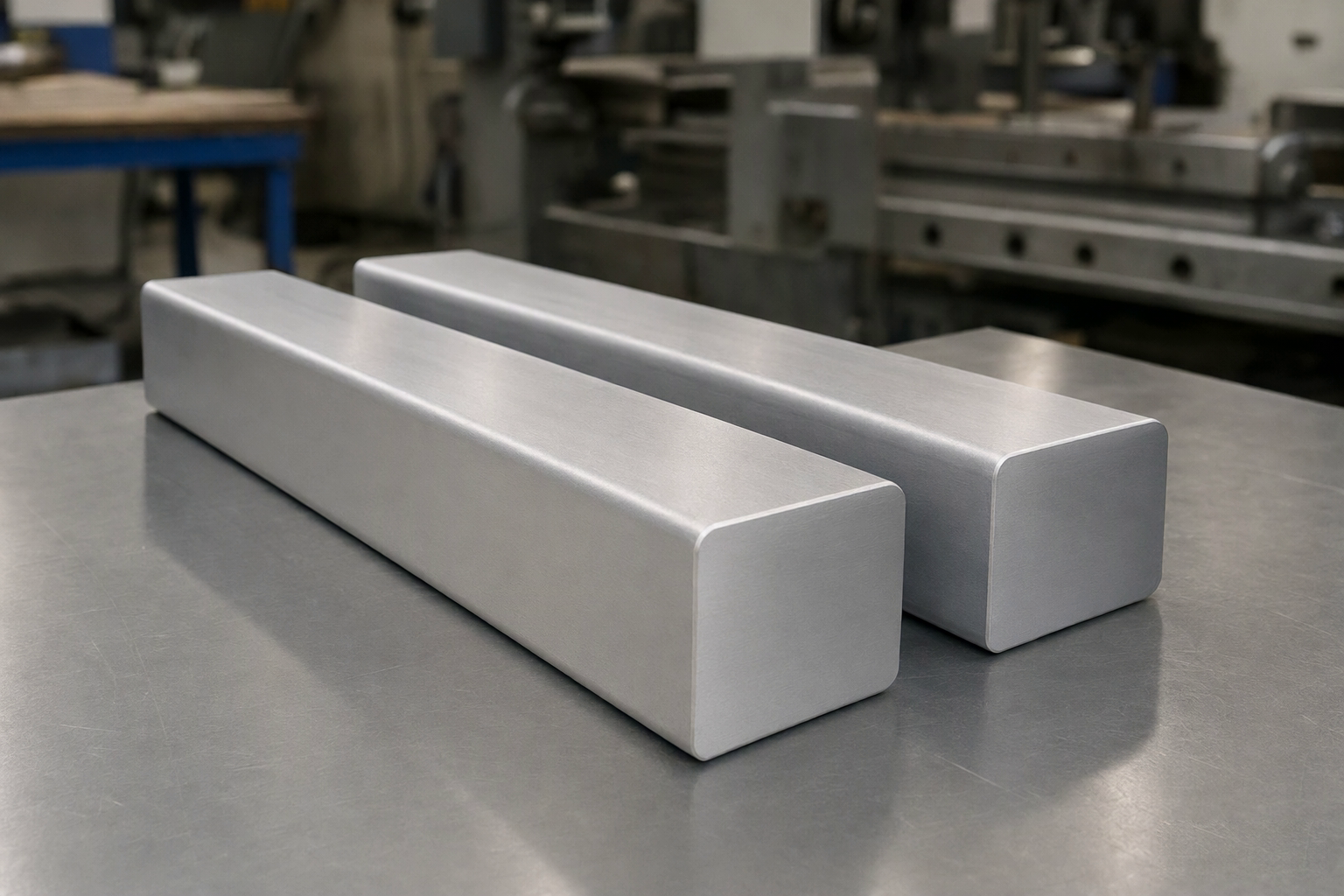
Key takeaway: 6082-T6 and 6061-T6 are the same alloy family wearing different passports. Cutting behavior is close enough that a proven program should not change. What does change is section size, stock format and paperwork: 6082 keeps more of its yield in thick plate, arrives in metric sizes with European certificates, and is often the only grade a European drawing will accept. If the part is under roughly 20 mm and the drawing does not name the grade, buy 6061.
Most American buyers meet 6082 for the first time when a drawing arrives from Germany, the Netherlands or the UK and the material callout is not a grade their local distributor stocks. The instinct is to ask for a substitution. Sometimes that is correct, and sometimes it quietly rewrites a structural calculation somebody else signed.
For most projects the 6061 vs 6082 aluminum decision is a supply-chain question first and an engineering question second. This guide puts 6082-T6 CNC machining beside 6061-T6 on the four things that actually decide the purchase: strength at your section thickness, behavior under the cutter, what the stock costs and how long it takes, and who is allowed to change the specification. The wider alloy picture is in our aluminum CNC machining materials guide.
1. Quick answer: 6082-T6 vs 6061-T6

Find the requirement that describes your part. The row you land on is the specification to write, not the one to argue about.
1-1. Decide it by the requirement, not the grade name
| The binding requirement | Specify | Why not the alternative |
|---|---|---|
| European drawing names EN AW-6082 | 6082-T6 or T651 | The grade callout is part of a calculation the designer approved; substitution is their decision |
| Machined plate thicker than about 20 mm that must hold yield | 6082-T651 | 6061 loses more strength as thickness rises and may not clear the load |
| Thin plate, pockets, prototypes, US delivery window | 6061-T651 | Inch sizes, wide distributor stock, specs most US shops already quote against |
| Welded frame that will be stress relieved later | Either, plus a stated temper | Welding anneals the zone locally in both alloys; the joint sets the strength |
| Bright decorative anodized finish | 6061 | 6082’s higher silicon and iron push the film toward gray rather than clear |
| Cost per part is the binding constraint | 6061 | 6082 in the US usually means import lead time and a minimum order, not a cheaper blank |
1-2. What this guide helps you avoid
- Offering a “free substitution” of 6061 on a structural part and having it rejected at the customer’s incoming inspection.
- Finding out the 6082 you ordered arrives as a 12 mm metric extrusion when the drawing was dimensioned in inches.
- Paying import lead time twice because the first lot carried an EN certificate your quality system could not file against the AA designation.
- Choosing 6082 for a thin bracket, where the strength difference sits inside a normal mill tolerance.
1-3. The three questions that decide
- How thick is the load-bearing section? Below roughly 20 mm the two grades are interchangeable on strength. Above it, 6082 keeps more yield.
- Who owns the specification? If the drawing names a grade, the right to change it belongs to whoever signed the calculation.
- Where does the stock come from this month? Availability is a supply question with a price and a date attached.
2. What 6082 is and why US buyers rarely see it

6082 is a heat-treatable aluminum-magnesium-silicon alloy of the same 6xxx family as 6061 and 6063. It is a mainstream structural grade in Europe and Australia, and an occasional visitor on North American purchase orders.
2-1. One alloy, four names
The same metal appears as AA 6082 in the Aluminum Association system, EN AW-6082 in Europe, DIN AlMgSi1 (material number 3.2315) in older German documents, and AlSiMgMn in the ISO registration. Treating those as four materials creates a paperwork problem out of nothing. The registered designation and its composition limits are published in the Aluminum Association’s Teal Sheets, the document to cite when somebody asks whether 6082 is a real grade.
2-2. Why the market split exists
There is no engineering reason the US defaults to 6061. It is history and inventory: domestic mills built their plate and extrusion ranges around it, aerospace purchasing wrote specs against it, and distributors stocked what turned. Europe standardized on 6082 for structures because it answers solution treatment better in the sections Europeans extruded. Both grades are registered internationally.
2-3. How it reaches your shop
In the US, 6082 usually arrives as imported extruded profile or as plate cut by a service center, in metric thickness and width. Extruded shapes fall under ASTM B221 and plate under ASTM B241, both published by ASTM International; European equivalents carry EN numbers. Expect metric mill dimensions and a certificate that names the temper instead of an AMS specification.
2-4. The paperwork difference is not cosmetic
A substitute grade needs three things to be legal in a quality-managed build: written approval from the design authority, a certificate mapping the lot to the called-out designation, and a record in the traveler. “We will send 6061, it is the same family” breaks all three. Our article on aluminum CNC machining in the US covers how certificate trails are handled on import work.
3. Where the chemistry differs
IMAGE NEEDED — real photograph. No illustration is placed here. The image service rejected this batch before a usable frame was produced, and a generic AI picture would not show what this section argues, so the slot is left open rather than filled. Suggested subject is named below.
Suggested subject: a macro or etched sample of extruded 6082 beside 6061 plate, showing grain and die lines, photographed in your incoming inspection area.
The gap between the two grades is small in absolute terms and meaningful in how the metal answers heat treatment.
3-1. Magnesium silicide does the work in both
6061 and 6082 harden the same way: magnesium and silicon dissolve at solutionizing temperature, the quench traps them, and artificial aging pulls them out as extremely fine particles. Those particles block dislocation movement, and blocking dislocation movement is what strength is, physically. Published ranges put 6082 near 0.7 to 1.3 percent silicon and 0.6 to 1.2 percent magnesium, against about 0.6 and 1.0 percent for 6061. 6082 carries more of the hardening pair in total.
3-2. Manganese is the addition that matters
6082 typically carries 0.4 to 1.0 percent manganese; 6061 carries almost none. Manganese refines the grain and forms hard intermetallic particles that slow recrystallization during hot working. The practical payoff is a stronger response to quenching in thick material, which is section 4. The price is a slightly more abrasive microstructure at the cutting edge and a duller anodic film.
3-3. Copper, and why less of it helps
6061 normally holds 0.15 to 0.40 percent copper, which buys a little strength and is written into the aerospace specification for 6061 sheet and plate, AMS 4027. 6082 keeps copper near 0.10 percent maximum, which improves corrosion behavior and welding at the cost of a little strength in thin sheet.
3-4. What the additions do not change
Density and stiffness are effectively identical: both near 2.70 g/cm3, both with an elastic modulus around 70 GPa, roughly one third of steel. A 6082 bracket and a 6061 bracket of the same shape deflect exactly the same. If the complaint is flex, the fix is geometry. That argument is made in full in our piece on when high strength aluminum is justified.
4. Strength by section thickness: the one real difference
IMAGE NEEDED — real photograph. No illustration is placed here. The image service rejected this batch before a usable frame was produced, and a generic AI picture would not show what this section argues, so the slot is left open rather than filled. Suggested subject is named below.
Suggested subject: a thick 6082 plate blank with a cut-off test coupon beside it, mill identification visible but customer details redacted.
This is where the grades genuinely part company, and where most substitution arguments go wrong.
4-1. The headline numbers are almost the same
Typical published values for thin material are close: 6082-T6 is usually quoted near 310 MPa (45 ksi) tensile with yield around 260 MPa (38 ksi), and 6061-T6 plate near 310 MPa (45 ksi) tensile with yield around 276 MPa (40 ksi). In a 6 mm bracket neither number is worth arguing about; both sit far above what the section can use, and the design is limited by stiffness.
4-2. Thick sections are where 6082 wins
Strength here depends on how fast the metal cools after solutionizing and how much hardening phase is available to precipitate. Thick material cools slowly at the center, so achievable strength falls as thickness rises. 6082’s larger magnesium-silicon content plus manganese gives it more quench reserve, so it keeps a bigger share of its yield in heavy plate. The direction is well established; the exact thickness bands and minimum values belong to the current revision of the governing specification and should be read from the standard, not from a datasheet summary.
4-3. How to read a thickness-dependent table
Three rules keep you honest. Check that the quoted range covers your actual section, not the nearest one. Check that the product form matches what you are buying, because extruded, rolled and plate material are not the same metal. Check that the temper suffix matches the delivery condition, because T6 and T651 are the same treatment with different stress relief.
4-4. T6 versus T651 is a separate decision
T651 means the plate was solution treated, aged, then stretched to relieve rolling and quench stress. Without that stretch a thick plate moves when you cut into it. That is a temper question, not a grade question, and it is worked through in our companion article on 7075-T6 versus T651. The same logic applies here.
5. Machining behavior: what changes at the machine

In 6082-T6 CNC machining the practical difference from 6061 is small enough that a proven program should not be rewritten because the grade changed. Four things move.
5-1. Tool wear and built-up edge
Manganese-bearing intermetallics are hard and the higher silicon makes the alloy slightly more abrasive, so expect marginally faster flank wear at the same feeds. The opposite failure is more common: run the cutter too lightly and aluminum welds to the edge, giving built-up edge, a torn pocket floor and a bore that drifts small. Increase feed per tooth before reducing speed.
5-2. Chips and the surface skin
Both alloys produce the same continuous spiral chip in milling, so chip control is a question of feed, coolant direction and peck strategy, not grade. What does change is that imported 6082 often arrives with a harder extruded skin, so the first pass cuts differently from the bulk. Take a light scoring pass, then run the real depth.
5-3. Finish and appearance
Finish on 6082 is normally good, but second-phase particles leave a more speckled look after a bright finish, and the material is less forgiving to polish. Judge appearance requirements against the anodizing outcome in section 7, not against the surface as it leaves the table.
5-4. Dust and swarf
Aluminum swarf is a combustible fine particulate and 6xxx dust should be treated as a controlled exposure: extraction at source, wet or vacuum cleanup instead of air blowdown, and handling per the safety data sheet for the alloy you actually received. If heat treatment or coating is done outside your shop, Nadcap accreditation through the Performance Review Institute is what most aerospace and automotive buyers expect to see.
6. Fixturing, stock format and metric assumptions

Most of the friction American shops report with 6082 is not cutting at all. It is the stock.
6-1. Inch versus metric dimensions
Imported 6082 arrives in metric thickness and width: 12 mm rather than 0.500 inch, 1500 mm sheet rather than 48 by 96 inches. If your saw setup, nesting software and tolerance stack assume inch stock, the substitution costs setup time before it saves anything.
6-2. Flatness and residual stress
Extruded profile is straight along its length but can be hollow across the width. Plate that was never stretched moves when material comes off one face. Separate roughing from finishing, let the part relax between operations, and specify mill stress relief on the drawing instead of machining your way out of a stress problem.
6-3. Datums both sides agree on
European drawings usually write datums to ISO conventions and geometric callouts to EN ISO 1101, while US inspection reports are often built around ASME Y14.5. The two systems describe the same geometry with different symbols. Confirm the datum features, not just the numbers, before cutting, because a first-article rejection caused by a datum reading is expensive in freight and calendar time.
7. Joining, finishing and service environment
IMAGE NEEDED — real photograph. No illustration is placed here. The image service rejected this batch before a usable frame was produced, and a generic AI picture would not show what this section argues, so the slot is left open rather than filled. Suggested subject is named below.
Suggested subject: a welded and anodized aluminum assembly from your own line, with the weld bead and the anodic film both visible.
Both alloys are weldable and both appear in structures that see weather. Neither is a marine grade the way 5083 is.
7-1. Welding 6082 and 6061
Both are fusion-weldable with filler classified under the American Welding Society’s aluminum filler specification, published by AWS. The usual choices are a silicon-bearing 4043-type filler, which flows better and resists hot cracking, or a magnesium-bearing 5356-type filler, which is stronger and closer in color after anodizing. Either way the weld and its heat-affected zone arrive near annealed strength, so design for that, or weld before machining and stress relieve.
7-2. Anodizing appearance
Silicon and iron do not dissolve cleanly in the anodizing bath, so 6082 films tend toward gray or smoky and dyed colors come out muted. 6061 anodizes brighter and is the better choice for visible parts. If the finish decision is still open, our comparison of anodizing versus powder coating covers film build, color and edge coverage.
7-3. Corrosion limits
In ordinary atmospheric service both grades perform well unfinished. In salt spray, immersion or a wet joint with steel fasteners, both need protection and a 5xxx alloy is usually the better starting point. Galvanic isolation matters more than the grade here: non-conductive washers and sleeves, no crevices holding electrolyte, and coat the hidden faces, not only the visible ones.
8. Sourcing, cost and lead time
IMAGE NEEDED — real photograph. No illustration is placed here. The image service rejected this batch before a usable frame was produced, and a generic AI picture would not show what this section argues, so the slot is left open rather than filled. Suggested subject is named below.
Suggested subject: a received pallet of metric-size imported aluminum plate with its packing documentation, all identifiers redacted.
For a US build the commercial difference is usually larger than the metallurgical one, and the 6061 vs 6082 aluminum cost gap is logistics rather than alloy content.
8-1. What 6082 costs in the American market
Where 6082 is not stocked locally you are buying an import or a mill run. That normally means a minimum quantity, a longer promise date, and a per-kilogram premium over 6061 plate. Get the blank cost and the date in writing before you quote the machined part, because the material is where the schedule risk sits.
8-2. When 6061 is right even on a 6082 drawing
Three cases: the part is thin and lightly loaded, so the strength difference is irrelevant; the customer’s qualification allows an equivalent 6xxx grade with documented substitution; or the drawing named 6082 only because that is what the designer’s distributor stocks. In all three the conversation belongs to the design authority, before the first article.
8-3. Never let the shop decide alone
A machined part is a manufactured document as much as a piece of metal. Whoever owns the calculation owns the material callout. Suppliers should propose substitutions in writing with the property comparison attached; buyers should answer in writing. That record protects both sides when the part is inspected two years later.
9. Specifying and buying checklist
Seven lines to check before 6082-T6 CNC machining is quoted, and before the plate is ordered. Each is cheap on paper and expensive after machining.
9-1. On the drawing
- Alloy and full temper written out, with the designation system named (AA, EN or ISO).
- Section thickness of the load-carrying feature stated, so the property band can be checked against the right range.
- Datum scheme confirmed across both tolerancing systems, with the standard named explicitly.
- Coating specified with its dimensional allowance, and appearance requirements separated from functional ones.
9-2. With the material and the supplier
- Mill certificate matched to the delivered lot and mapped to the designation your quality system files under.
- Stock format confirmed in the units you machine in, with flatness and stress relief stated.
- Substitution approval in writing from the design authority before the first cut, not after the first article.
10. Conclusion: 6082 for the thick section or the European chain
10-1. Treat the grade as a supply decision first
If the drawing does not name 6082 and the section is thin, machine 6061 and skip the import lead time.
10-2. Treat thickness as the engineering decision
Above roughly 20 mm of load-bearing plate, 6082 keeps more of its yield. That is a real reason to specify it.
10-3. Treat temper as a separate question
T6 versus T651 decides how much the part moves on the machine. It is not the same conversation as grade selection.
10-4. Write the whole specification down
Alloy, designation system, temper, section, certificate mapping and substitution approval. Six lines that cost nothing and prevent the expensive argument.

Frequently asked questions about 6082-T6 CNC machining
Is 6082 stronger than 6061?
Not in thin material, and yes in heavy plate. Typical published tensile values are both near 310 MPa (45 ksi), while 6061-T6 yield sits slightly higher in thin sheet at about 276 MPa (40 ksi). In the 6061 vs 6082 aluminum comparison the crossover happens in the thickness ranges: as sections grow, 6082 keeps more yield because it tolerates a slower quench.
Can I substitute 6061-T651 for 6082-T6 on a European drawing?
Only with written approval from whoever owns the design. The grades are close in thin section, so engineering risk is often low, but qualification risk is not: a named grade is part of an approved calculation, and an undocumented substitution fails incoming inspection even when the part measures perfectly.
Does 6082 machine slower than 6061?
Not meaningfully. Expect a small rise in abrasive flank wear from the manganese-bearing particles and a harder extruded surface skin on the first pass. Feeds, speeds and tool paths proven on 6061 normally transfer directly, with a light scoring pass added at the start.
Why does my 6082 anodize gray when 6061 comes out clear?
Silicon and iron in the alloy do not dissolve cleanly in the anodizing bath, so the film looks gray or smoky. 6082 carries more silicon than 6061, which strengthens the effect, and dyed colors come out muted for the same reason. If appearance is the requirement, specify 6061 or move to an opaque coating.
Is 6082 a good alloy for marine parts?
It performs acceptably with protection, but it is not the natural choice. Marine structures normally start from a 5xxx alloy such as 5083, which does not depend on heat treatment for strength. If you use 6082 near seawater, plan the coating and galvanic isolation before the machining.
What lead time should I allow for 6082 plate in the US?
6061-T651 plate is usually a same-week purchase from a domestic service center. 6082 is commonly an import or a mill run, so expect a minimum order and a promise date measured in weeks. Confirm blank cost and date before quoting, because the material is where the schedule risk sits.
Glossary
- 6xxx alloy — a heat-treatable aluminum alloy strengthened mainly by magnesium and silicon.
- Solution heat treatment — heating so alloying elements dissolve, then quenching to trap them in place.
- Artificial aging — the moderate-temperature hold that precipitates the hardening particles, the “6” in T6.
- T651 — T6 plus a stretch that relieves internal stress, the usual form for machined plate.
- Quench sensitivity — how much strength a section loses when it cools slowly, which is what separates thick plate.
- Built-up edge — aluminum welded onto the cutting edge during a too-light cut, then torn into the finished surface.
- Mill certificate — the document reporting tested properties for the delivered lot, and the record a substitution must match.
References
- The Aluminum Association. Teal Sheets: International Alloy Designations and Chemical Composition Limits for Wrought Aluminum and Wrought Aluminum Alloys. Registered designation and composition limits for 6082 and 6061. (aluminum.org/teal-sheets)
- The Aluminum Association. Aluminum Standards and Data, together with ANSI H35.1 alloy and temper designation systems. (aluminum.org)
- SAE International. AMS 4027 — Aluminum Alloy Sheet and Plate, 1.0Mg – 0.60Si – 0.28Cu – 0.20Cr (6061; -T6 sheet, -T651 plate), Solution and Precipitation Heat Treated. (sae.org — AMS 4027)
- ASTM International. B221 Aluminum and Aluminum-Alloy Extruded Bars, Rods, Wire, Profiles and Tubes, and B241 Aluminum and Aluminum-Alloy Plate for General Purposes. (astm.org)
- American Welding Society. Aluminum welding filler metal classifications for 4043- and 5356-type fillers. (aws.org)
- ASME. Y14.5-2018 — Dimensioning and Tolerancing. Datum reference frames and geometric controls. (asme.org — Y14.5)
- Performance Review Institute. Nadcap special process accreditation for heat treating, welding and surface finishing. (p-r-i.org)

Leave a Reply