
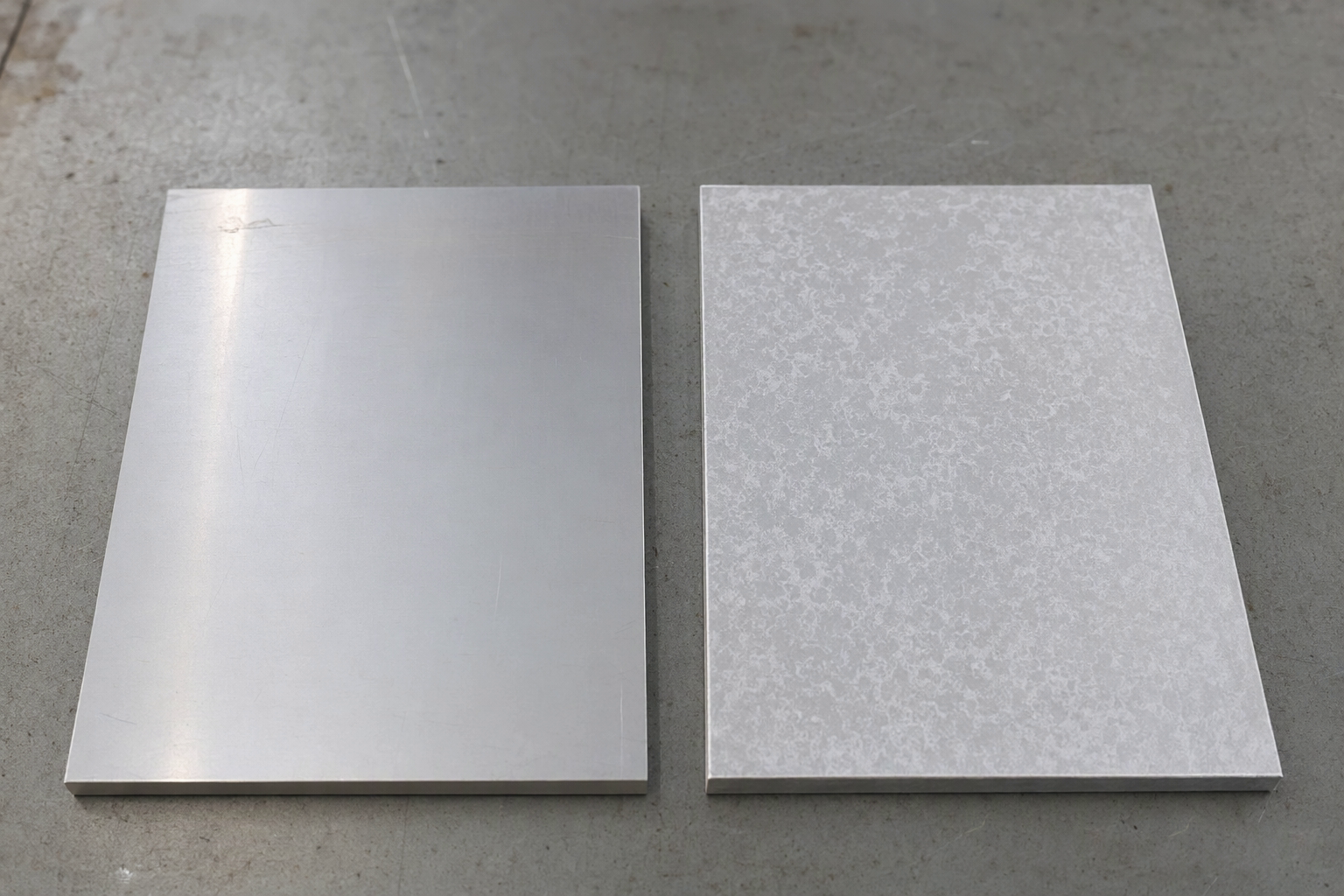
Key takeaway: Choose 5052 when the part is formed, machined or fabricated sheet that needs good corrosion resistance and moderate strength. Choose 5083 when the part is welded plate that must carry load in salt water, or when a marine or pressure-vessel specification names it. The dividing line is not strength and not price. It is magnesium content, and magnesium content brings a service-temperature limit that most buyers never hear about until an inspection report mentions it.
Both alloys sit in the 5xxx family: aluminum strengthened by magnesium rather than by heat treatment. That one fact decides how they weld, how they age, how they machine and how they eventually fail. This guide compares 5052 vs 5083 aluminum on the four questions a purchasing engineer has to answer.
If the real decision is between alloy families rather than between two magnesium levels, our aluminum CNC machining materials guide covers the whole field, and the companion article on when high strength aluminum is justified covers the 7xxx end of it.
1. Quick answer: 5052 vs 5083 aluminum

1-1. Decide it by the requirement, not the grade number
| The binding requirement | Specify | Why not the alternative |
|---|---|---|
| Formed sheet enclosure, bracket or tank | 5052-H32 | 5083 springs back harder, costs more per sheet and is stocked as plate |
| Welded structure carrying load in marine service | 5083-H116 or H321 | 5052 gives up roughly a third of the usable strength in the same thickness |
| Part will see sustained heat above about 65 C | 5052, or a 6xxx alloy | High-magnesium 5083 can sensitize at those temperatures over years of service |
| Cryogenic or cold-climate tank and vessel work | 5083-O | 5052 stays tough too, but the plate specifications and class rules point at 5083 |
| Bright or decorative anodized finish | Neither; use 5005 or 6061 | Both 5xxx alloys anodize gray, and the higher the magnesium the duller the film |
| Thin machined plate with tight flatness | Either, plus a stress-relief step | Flatness is a processing question, not an alloy question, in both grades |
1-2. What this guide helps you avoid
- Specifying 5083 for a formed sheet part and paying plate prices for a job 5052 does better.
- Discovering at weld qualification that the marine drawing expects an H116 or H321 certificate, and the stock you bought is H321 in name only.
- A part that survives commissioning and then fails years later in a hot, damp compartment because nobody asked about service temperature.
- Ordering bright anodized 5052 hardware, which is a finish this family cannot deliver.
1-3. The three questions that decide
- Is it sheet or plate? 5052 is the forming and sheet-metal grade. 5083 is the plate and welded-structure grade.
- Will it get hot in service? Sustained heat above roughly 65 C is where the high-magnesium alloy stops being the safe answer.
- Who certifies it? Marine and pressure-vessel work buys a certificate trail, not just a metal.
2. What these two alloys actually are

2-1. Neither alloy can be hardened by heat treatment
This is the sentence that matters most. A 6xxx alloy such as 6061 is strengthened by solution heat treatment and aging, and a 7xxx alloy such as 7075 even more so. A 5xxx alloy is hardened only by cold work: the magnesium sits in solid solution, and rolling or stretching is what raises the strength. The practical consequence is that welding does not destroy a heat-treatment condition in 5052 or 5083 the way it does in 6061, because there is no heat-treatment condition to destroy. The heat-affected zone still softens where the metal was cold worked, but it softens toward the annealed condition rather than collapsing.
2-2. Magnesium does the work, and the gap between the two grades is magnesium
Published composition limits put 5052 at roughly 2.2 to 2.9 percent magnesium with 0.15 to 0.35 percent chromium. 5083 goes to 4.0 to 4.9 percent magnesium, adds 0.40 to 1.0 percent manganese, and holds copper below about 0.10 percent. The registered designations and their limits are published in the Aluminum Association Teal Sheets. That extra magnesium is what buys the strength, and it is also what creates the temperature sensitivity discussed in section 4. Almost every real 5052 vs 5083 aluminum decision traces back to this one number.
2-3. The tempers you will see on a drawing
Because strength comes from cold work, the temper code tells you how much deformation the mill put into the plate. O is annealed and soft. H32 or H321 is quarter-hard with a stabilizing treatment, common for welded structures. H116 is the marine temper with the same strength band and explicit corrosion testing. H34 and harder are possible but less common in plate. The designation system itself is ANSI H35.1, published through the Aluminum Association.
2-4. What stays the same between them
Density is 2.68 g/cm3 for 5052 and 2.66 for 5083, both effectively the same as every other aluminum alloy, and the elastic modulus is around 70 GPa in both. Neither alloy makes a stiffer part than the other, and neither makes a stiffer part than 6061. If deflection is the complaint, the answer is section geometry.
3. Strength by temper and thickness

3-1. The published numbers
| Alloy and temper | Tensile | Yield | Where it comes from |
|---|---|---|---|
| 5052-H32 | 280 min | 230 min | General sheet and plate specification |
| 5083-O | 275 to 350 | 125 to 200 | Annealed, for forming and cryogenic work |
| 5083-H321 | 305 to 385 | 215 min | Welded structures, marine temper |
| 5083-H116 | 305 min | 215 min | Marine plate, corrosion tested |
3-2. Thickness cuts both ways
In the marine tempers, published properties drop above roughly 40 mm of thickness, in one widely quoted data set from 305 MPa tensile and 215 MPa yield down to 285 MPa and 200 MPa. That is the honest shape of the table: the thick plate is still strong, but the number you designed with may belong to a thinner band. Ask for the property table at your actual thickness, not the nearest one.
3-3. What that means for a machined part
A 5083 fitting machined from 25 mm plate is carrying a real structural load, and the alloy earns its premium there. A 5052 bracket machined from 8 mm plate is usually limited by stiffness and by how well it is held, not by strength. Choosing the higher-grade alloy for the second part buys nothing except a longer lead time, the same conclusion our 6061-T6 CNC machining guide reaches from the other direction.
4. Corrosion behavior: the real dividing line

4-1. In ordinary service both are excellent
Neither alloy needs a coating to survive a dry industrial or marine-atmosphere environment. Both form a stable oxide, both resist the general attack that ruins unprotected steel, and both are a better choice than 6061 where standing salt water is the problem. The corrosion resistance of the 5xxx family is one of the reasons it is the default for hulls, decks, tankage and coastal structures. In a 5052 vs 5083 aluminum corrosion comparison the honest verdict is a tie, with 5083 ahead only where welded plate strength is the constraint.
4-2. The difference is what happens when it gets hot
Aluminum-magnesium alloys above roughly 3 percent magnesium can precipitate a brittle, anodic phase along the grain boundaries when they are held warm for long periods. The literature puts the onset as low as about 50 °C given enough years, and the consequence is sensitization: the grain boundaries become electrochemically active, and the alloy becomes susceptible to intergranular corrosion and to intergranular stress-corrosion cracking. A widely cited review of this mechanism in AA5083 was published in the journal CORROSION (Lim, Kelly and Scully, 2016), and the corrosion profession that maintains those test methods is AMPP.
The practical rule most designers work to is simple: keep high-magnesium 5xxx below roughly 65 °C of sustained service temperature, and limit how much cold work it carries if it will be warm. 5052, at about half the magnesium, does not have the same exposure. That single limit disqualifies 5083 from engine compartments, hot process skids, and any compartment that bakes in the sun for years, and it is the reason a 5052 or 6061 part is often the correct answer where an inspector later says 5083 was over-specified.
4-3. Galvanic coupling matters more than the grade choice
Both alloys are anodic against steel, stainless fasteners and copper alloys. In a wet joint, the aluminum is the metal that is consumed. Isolate with non-conductive washers and sleeves, do not create crevices that hold electrolyte, coat the hidden faces rather than only the visible ones, and drain the joint. Changing from 5052 to 5083 does not fix a galvanic problem; the fastener stack-up does.
4-4. How marine plate is actually certified
This is where the two grades separate commercially rather than metallurgically. Marine high-magnesium sheet and plate is bought to ASTM B928M, the specification written for exactly this service after corrosion problems in ship structures forced the industry to test for it. B928M restricts 5083 to the H116 and H321 tempers and requires exfoliation and intergranular corrosion testing, commonly ASTM G66 and G67. General-purpose sheet and plate falls under ASTM B209M instead, which does not carry those requirements.
Classification societies then sit on top of the material specification. Builders buying hull, deckhouse or tank plate normally need the certificate endorsed by a classification society, whose aluminum rules cover both the material and the welding. If your purchase order does not name the specification and the temper, the mill will send what it has, and the paperwork will not match the drawing.
5. Machining behavior at the machine

5-1. Built-up edge is the main event
Neither alloy cuts like a free-machining metal. Both smear, and aluminum welds onto a cutting edge that is being run too lightly for its geometry. The symptoms are identical in 5052 and 5083: a torn surface, a bore that drifts small, and a pocket floor that looks chewed. The fix is the same too, raise feed per tooth before you lower speed, use a polished high-rake flute, and keep the cutter moving at a real chip load.
5-2. Where they differ under the cutter
5083 in the harder tempers is firmer and slightly more resistant to deflection, so deep pockets and thin walls hold size better than the same geometry in 5052. 5052 in annealed or quarter-hard condition is softer and more forgiving to form, but it will flex away from the cutter. Suppliers describe 5083 machinability as good in the harder tempers and fair in the soft ones, which is the honest summary: in 5052 vs 5083 aluminum machining, the temper matters more than the grade.
5-3. Thin sheet is a different problem
Most 5052 work that reaches a CNC shop is thin gauge. Thin sheet does not want to be clamped hard, because it oil-cans and then springs back after the cut. Backing plates, low clamping force, tape or vacuum fixtures, and a single finishing pass beat heavy clamping every time. If a 5052 sheet part is failing flatness, the process plan is the place to look, not the alloy.
5-4. Dust, swarf and heat
Aluminum fines are combustible. Grind or sand 5xxx material with extraction at source, clean up wet or by vacuum rather than with air lines, and follow the safety data sheet for the alloy you received. 5xxx swarf also carries more magnesium, which makes it more reactive in some cutting-fluid chemistries, so keep fluids fresh and monitor pH on mixed swarf bins.
6. Fixturing, forming and stress

6-1. Stress relief is not optional in plate
Roll and quench leave stress in plate, and machining relieves it by removing the material that was holding the balance. Rough, then let the part relax, then finish. Where flatness matters, buy stretched plate: the 5xxx equivalent of the 6061-T651 logic is a levelled or stress-relieved product, and the same argument about mill temper applies. Our companion piece on 7075-T6 versus T651 works through that failure mode in detail, and it reads the same way here.
6-2. Forming favors 5052
If the part is bent rather than cut, 5052 gives more stretch before it cracks at the same strength level, and its minimum bend radii are tighter. 5083 forms well in the annealed condition and poorly in H116 or H321, where springback and edge cracking appear. A design that needs a deep draw plus weldment is usually a 5052-O or 5083-O drawing, not a high-temper plate drawing.
6-3. Datums and measurement
Soft aluminum moves under a measuring force that would not bother steel. Use consistent datum features, low-force probing where the drawing allows it, and state the measurement method next to the tolerance. Geometric callouts written to ASME Y14.5 are the common language between the shop and the inspector, and they keep a flatness argument from turning into a fixture argument.
7. Where each alloy is used

7-1. Where 5052 is the default
Electrical and instrument enclosures, vehicle and aircraft sheet parts, fuel and hydraulic tanks, marine hardware, treadplate, ducting, formed brackets, and any part whose cost is dominated by how much forming it needs. It is the alloy a fabricator reaches for when corrosion resistant aluminum components are required but the load is modest.
7-2. Where 5083 is the default
Hull and deckhouse plate, workboat and yacht structures, offshore and subsea frames, rail car bodies, truck and tanker bodies, welded pressure vessels and tankage, cryogenic and LNG-service equipment, and machined fittings cut from that same plate. The common thread is welded plate carrying real load in a wet environment, which is precisely the case the alloy was developed for.
7-3. Where neither is right
Hot compartments and sustained service above roughly 65 °C, a bright decorative anodized finish, or a stiffness complaint. None of those three are solved by moving from 5052 to 5083. A heat or stiffness problem points at a 6xxx alloy, and a genuine strength problem points at the 7xxx decision laid out in our guide to high strength aluminum CNC parts.
8. Sourcing, certificates and cost

8-1. Stock and lead time
5052 is stocked in sheet gauges almost everywhere in the US, in inch sizes, from a service center that can cut to size the same week. 5083 is a plate product; the marine tempers are stocked more thinly, often metric, and class-certified plate is usually a scheduled mill purchase rather than a counter sale. If your schedule assumes same-week material, that is where a 5052 vs 5083 aluminum decision stops being technical and becomes a purchasing problem.
8-2. The certificate trail is part of the product
For B928M plate, the paperwork is not a formality: it records the temper, the exfoliation and intergranular test results, and the society endorsement. Buy 5083 H321 as generic B209M plate and you have a structurally similar metal that cannot be used where the certificate is required. Ask which classification society endorses the lot — ABS is the name most US buyers see — then write the specification into the purchase order. Our article on aluminum CNC machining in the US covers how to read a supplier certificate package.
8-3. Finish decisions
Neither alloy is a decorative anodizer. Clear anodizing on 5xxx comes out gray to smoky and darker with higher magnesium, so most marine parts are left bare, painted, or given a chemical conversion coating; non-hexavalent conversion coatings are covered by ASTM B921, and the corrosion profession behind those test methods is AMPP. If a customer asks for a bright finish on 5052 hardware, the honest answer is a different alloy or a different finish family, which is the subject of our comparison of anodizing versus powder coating.
9. Specifying and buying checklist
Seven lines to check before a 5xxx part is quoted, and before the plate is ordered. Each one is cheap on paper and expensive after machining.
9-1. On the drawing
- Alloy and full temper written out, including the H-code suffix, not just 5052 or 5083.
- Specification named: B209M for general product, B928M where marine corrosion testing is required.
- Sustained service temperature stated, so the 65 °C limit is checked rather than discovered.
- Datum scheme and measurement method written next to the flatness and tolerance callouts.
9-2. With the material and the supplier
- Mill certificate matched to the delivered lot, showing the temper and the test results the job needs.
- Property values read at your actual thickness band, not at the nearest one in the table.
- Finish plan agreed early: conversion coating or paint, because bright anodizing is not available in this family.
10. Conclusion: 5052 for the sheet, 5083 for the welded plate
10-1. Lead with the product form
If the part is formed sheet metal, start at 5052. If it is welded plate carrying load in a wet environment, start at 5083.
10-2. Then check the temperature
Sustained heat above roughly 65 °C is the one place 5083 can be the wrong answer for reasons that do not appear in a strength table.
10-3. Then check the certificate
Marine and pressure work buys ASTM B928M plate with exfoliation and intergranular testing and a society endorsement. Generic plate is cheaper and unusable.
10-4. Then machine it like aluminum
Sharp tooling, real chip load, controlled clamping, and a stress-relief step between roughing and finishing. That applies to both grades, and it decides the flatness you will be judged on.

Frequently asked questions about 5052 vs 5083 aluminum
Is 5083 better than 5052 for corrosion resistant aluminum components?
Not automatically. Both are among the best corrosion-resistant choices you can buy in sheet and plate, and both outperform 6xxx alloys in salt water. 5083 wins where welded plate must carry load and a marine specification must be satisfied; 5052 wins in formed parts, in hot compartments and where the certificate trail is not required.
Can I weld 5052 and 5083 together?
Yes, with a 5xxx filler such as 5183 or 5356 classified under the American Welding Society filler metal specifications published by AWS. Expect the joint to be weaker than the harder member because the heat-affected zone anneals back toward the soft condition. Design the weld for the lower strength, not for the base plate.
What is the maximum service temperature for 5083?
Keep sustained service below roughly 65 °C, a limit tracked in the corrosion literature and by marine classification rules. Above that, over years rather than months, the high magnesium content can precipitate an anodic phase at the grain boundaries and the alloy becomes sensitive to intergranular corrosion and stress-corrosion cracking. Exact limits belong to the design code you are working to, and marine classification rules state them explicitly.
Which is cheaper, 5052 or 5083?
Per kilogram, 5052 sheet is normally the cheaper material and is stocked in far more sizes. 5083 is a plate product, and class-certified marine plate in H116 or H321 carries both a price and a lead-time premium. The real cost driver is usually the certificate, not the alloy.
Can 5052 or 5083 be anodized for a bright finish?
Not convincingly. Both give a gray to smoky film, and 5083 is duller because of its magnesium content. Use a chemical conversion coating to ASTM B921, paint or powder coat, or change the alloy if a bright decorative surface is a hard requirement.
Does either alloy machine well?
Both machine acceptably if you treat them as gummy aluminum: sharp polished flutes, real feed per tooth, rigid support on thin parts, and a light finishing pass. 5083 in the harder tempers holds edges better than 5052 in soft temper, which is why the temper you order changes how the part machines more than the grade does.
Glossary
- Non-heat-treatable alloy — a grade whose strength comes from cold work or solid-solution alloying, not from solution treating and aging.
- Solid-solution strengthening — magnesium atoms in the aluminum lattice that make dislocation movement harder.
- H-temper — the cold-work code, such as H32, H116 or H321, that tells you how much deformation the mill put in.
- Sensitization — grain-boundary precipitation in high-magnesium alloys caused by long warm exposure, which opens the door to intergranular attack.
- Intergranular corrosion — attack that follows grain boundaries instead of eating the surface evenly.
- Exfoliation — a layered, leaf-like form of intergranular attack that swells and flakes plate.
- Class-certified plate — material whose production and testing were witnessed by a classification society such as ABS.
References
- Lim, M. L. C., Kelly, R. G., Scully, J. R. Overview of Intergranular Corrosion Mechanisms, Phenomenological Observations, and Modeling of AA5083. CORROSION, vol. 72, no. 2, 2016, pp. 198ff. (doi.org/10.5006/1818 (doi.org/10.5006/1818))
- The Aluminum Association. Teal Sheets: International Alloy Designations and Chemical Composition Limits for Wrought Aluminum and Wrought Aluminum Alloys. Composition limits for 5052 and 5083. (aluminum.org/teal-sheets (www.aluminum.org/teal-sheets))
- The Aluminum Association. Aluminum Standards and Data, and ANSI H35.1 alloy and temper designation systems. (aluminum.org (www.aluminum.org))
- ASTM International. B928M High Magnesium Aluminum-Alloy Sheet and Plate for Marine Service, B209M Aluminum and Aluminum-Alloy Sheet and Plate, B921 Non-hexavalent Chromium Conversion Coatings, and test methods G66 and G67. (astm.org (www.astm.org))
- American Bureau of Shipping. Rules for Materials and Welding (Part 2), covering aluminum as well as steel materials and welding. (eagle.org (ww2.eagle.org))
- American Welding Society. Aluminum filler metal classifications, including 5183- and 5356-type fillers. (aws.org (www.aws.org))
- AMPP (Association for Materials Protection and Performance). Corrosion standards, test methods and the CORROSION journal. (ampp.org (www.ampp.org))

Leave a Reply