
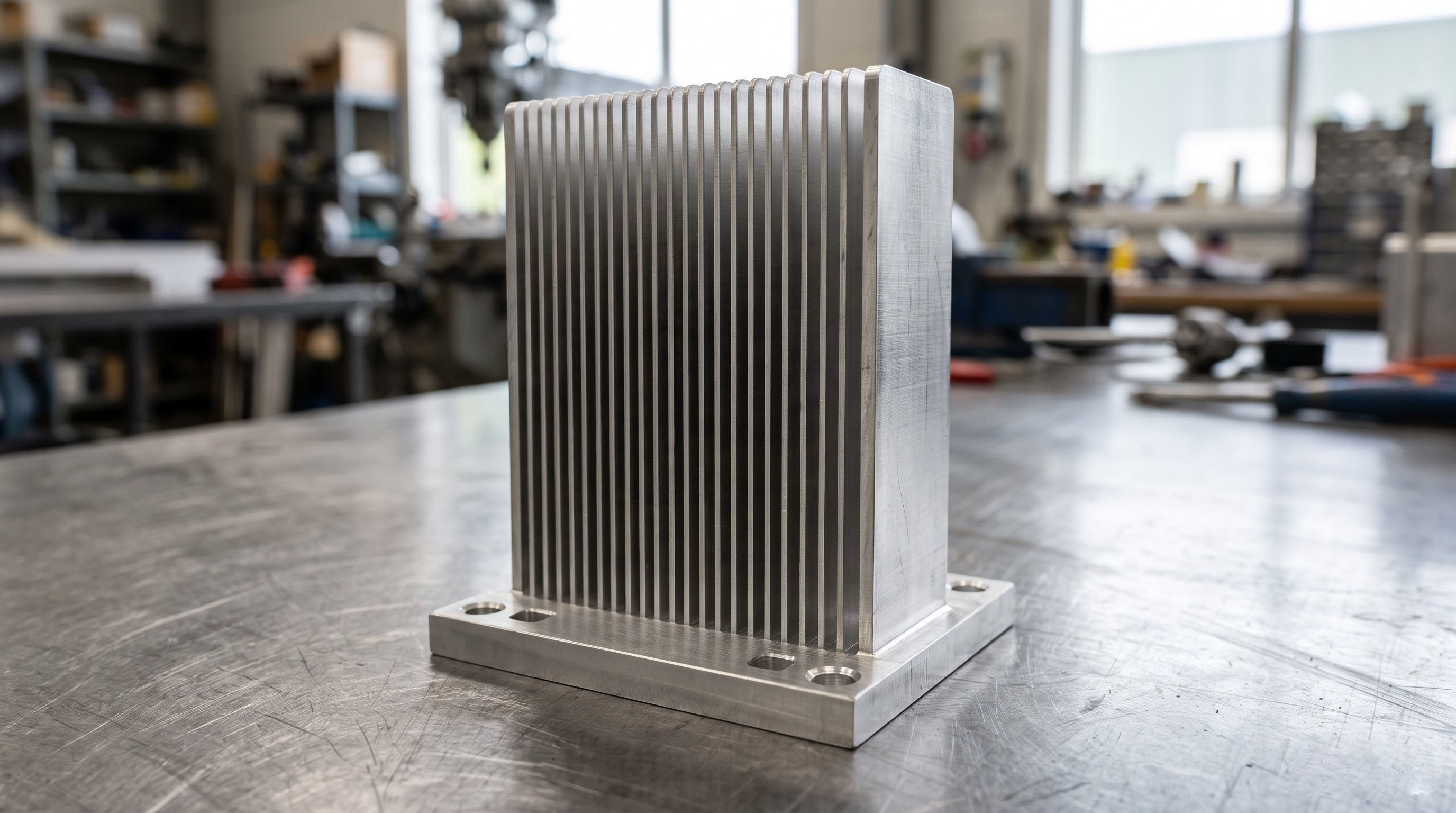
Key takeaway: Choose 6063 aluminum machining when the part has to look good, conduct heat, or start life as an extruded profile. It is the finishing and extrusion grade of the 6xxx family, not the strength grade. If the binding requirement is yield, you want 6061 or 7075. If it is surface appearance, thermal path or cross-section complexity, 6063 wins, and it wins by enough that the decision is rarely close.
Most buyers reach for 6063 from one of three directions: a housing that must anodize evenly, a heat sink that must move watts, or a part that is really an extrusion with machined ends. The costly mistake is assuming an extruded profile behaves like a machined blank.
For the wider alloy picture, our aluminum CNC machining materials guide compares every common grade.
1. Quick answer: when 6063 is the right call

Find the requirement that describes your part. The row you land on is the specification to write.
1-1. Decide it by the requirement, not by habit
| The binding requirement | Specify | Why not the alternative |
|---|---|---|
| Visible part, clear or colored anodizing | 6063-T5 or T6 | 6061 films duller and more varied; 5052 goes gray, 7075 goes muddy |
| Heat path from a device to ambient air | 6063-T5 extrusion, machined base | Published conductivity for 6063 sits near 200 W/m.K against roughly 155 to 170 for 6061 |
| Long thin frame with a complex cross-section | 6063-T5 extrusion | 6061 extrudes, but at higher press load, thinner-wall limits and more scrap |
| Yield strength in a machined pocketed part | 6061-T651 plate | 6063-T6 gives around 170 MPa yield against 276 MPa for 6061-T6 |
| Welded assembly that stays straight | 6063 or 5083 | 6063 welds cleanly and has no stress-corrosion reputation to manage |
| Small machined batch, no new die | 6061 or 6063 bar and plate | An extrusion die is a capital decision; below a few hundred pieces it rarely pays |
1-2. What this guide helps you avoid
- Paying a die charge and eight weeks of lead time for a shape you could mill from stock in a week.
- Clamping an extruded profile flat on the machine, cutting it, and watching it spring back out of tolerance when the clamps come off.
- Approving a color sample on one lot and receiving a different color on the next, because iron and surface condition were never specified.
- Calling out 6061 out of habit on a visible part and then paying for a finish that still looks cloudy.
1-3. The three questions that decide
- Will the part be looked at? 6063 is the alloy the finishing line likes.
- Does heat have to travel through it? Then conductivity is a design input, not a footnote.
- Is the shape a profile or a block? A long constant cross-section wants an extrusion; a chunk wants plate.
2. What 6063 actually is

2-1. A deliberately lean magnesium-silicon alloy
6063 is an Al-Mg-Si alloy with less alloying in it than 6061. Published composition limits put magnesium at 0.45 to 0.9 percent and silicon at 0.20 to 0.6 percent, with copper, manganese, chromium, zinc and titanium each held at 0.10 percent or below and iron at 0.35 percent maximum. The registered designations and their limits are published in the Aluminum Association Teal Sheets.
Strength comes from magnesium silicide, which forms only when magnesium and silicon are present in roughly the right ratio. The lean chemistry is not an accident: it is what lets the metal flow into a complex die at a lower press load, and it is what leaves a clean, even surface for the anodizing line. The same chemistry is why 6063 does not carry the stress-corrosion reputation that 7xxx alloys do.
2-2. T5 and T6 mean two different factories
T5 means the profile was cooled straight after extrusion and then artificially aged. The quench is the run-out table, not a heat-treat furnace. T6 means the part was solution heat treated in a furnace, quenched, and then aged, which buys strength and hardness. For 6063 aluminum machining this matters twice over: T6 cuts better because it forms chips instead of smearing, and T6 costs more because somebody had to put the profile through a furnace cycle that thin sections survive poorly.
2-3. The forms you can buy
Extruded profile is the native form, and it is the reason the alloy was written. Bar and tube exist; plate is uncommon, because plate is what you order when you cannot extrude.
3. 6063 vs 6061: where the trade flips

3-1. The numbers, honestly
Published typical minimums put 6063-T6 around 205 to 215 MPa tensile and 170 MPa yield, with hardness near 73 HB. 6061-T6 sits near 310 MPa tensile and 276 MPa yield at around 95 HB. That is a real gap of roughly forty percent in yield, and it is why a structural bracket is a 6061 or 7075 conversation. Read the exact band for your product form and thickness from the governing specification rather than from any article.
| Property | 6063-T6 | 6061-T6 | Which one wins |
|---|---|---|---|
| Yield strength | about 170 MPa | about 276 MPa | 6061, clearly |
| Thermal conductivity | about 200 W/m.K | about 155 to 170 W/m.K | 6063, by roughly a quarter |
| Extrudable wall and complexity | thinnest walls, easiest flow | workable, higher press load | 6063 |
| Anodized appearance | brightest, most even color | slightly hazier | 6063 |
3-2. Stiffness does not move
Both alloys sit near 70 GPa elastic modulus, the same as every other aluminum alloy. Choosing 6061 over 6063 does not make a part stiffer; it makes it stronger. If the complaint is deflection, the fix is the cross-section, which is exactly what an extrusion lets you do cheaply. Our guide to 6061-T6 CNC machining covers the stronger option, and the comparison of 6082-T6 and 6061-T6 covers the European middle ground.
4. Parts that start as an extrusion

4-1. The die is the decision
An extrusion is a tooling purchase before it is a material purchase. A new die costs money and weeks, and the mill then holds it for your repeat orders. Below a few hundred pieces of the same cross-section, milling from bar or plate is usually cheaper overall. Above that, the extrusion wins on both weight and cycle time, because the press makes the shape in one pass and 6063 aluminum machining is left to do only the faces that actually matter.
Extruded shapes for these alloys are bought to ASTM B221, published by ASTM International, which sets the dimensional and straightness tolerance classes. Ask which class the mill is quoting, because the gap between mill tolerance and your drawing tolerance is the stock you have to machine away.
4-2. Straightness is the trap
A profile leaves the press hot, is quenched, is stretched and sawn, and still carries residual stress and a mill straightness band. Clamp it flat, machine a face, release the clamps, and the part can move. Two habits prevent the argument: machine the datum face first and let the part relax before finishing, and hold straightness claims to the mill tolerance unless you are paying to true each part.
4-3. Die lines, skin and the first cut
The extruded surface carries lengthwise die lines and a slightly different skin than the bulk. Your first facing cut removes it. If a drawing keeps an as-extruded surface as the finish, decide that on purpose: anodizing shows die lines and machined areas as two textures.
4-4. Where 6063 helps the welder
Frames are welded, and 6063 is one of the friendlier structural alloys to join, with 4043 or 5356 filler classified under the American Welding Society specifications. The heat-affected zone still softens because the temper is destroyed locally, so design for the softened condition or weld before the final machining pass.
5. Enclosures and housings

5-1. The build that actually happens
A typical housing is an extruded body cut to length, two machined end faces, drilled or tapped mounting features, and a machined lid seat. The lid is often a separate machined part. Every one of those operations references a datum, so decide the datum before the drawing, not on the machine. Geometric callouts written to ASME Y14.5 keep the lid seat, the flange flatness and the hole pattern in one conversation instead of three.
5-2. Wall thickness and the feel of the part
Extrusions make thin walls cheap, so enclosures and sinks end up thin. Thin walls ring, flex under screw torque and pass machine vibration into the finish. A rib, a fillet or a slightly thicker wall costs grams and fixes both.
5-3. EMI, gaskets and the finish conflict
An anodic film is an insulator. If the enclosure is doing shielding or bonding work, the finish has to be masked where contact is required, or a conductive conversion coating chosen instead. Put that on the drawing before the first order, because it arrives late and expensively otherwise.
6. Aluminum heat sink machining

6-1. Why this alloy and not the stronger one
Heat moves through the metal, and the property that matters is conductivity, not strength. Published typical values put 6063 near 200 W/m.K against roughly 155 to 170 W/m.K for 6061, with pure aluminum around 237. The leaner chemistry that makes 6063 easy to extrude is the same reason it conducts better. The Aluminum Association publication Aluminum Standards and Data is where the property tables live, and the document to quote when a datasheet argument starts.
6-2. Fins are a die conversation
Extruded fins are limited by what the die can push metal around: height is usually a few times the fin thickness, and beyond that the fins bend, weld shut or come out uneven. When the design needs more surface than a die can give, the usual answers are skiving, milling fins into a block, or a separate fin stack. Each of those is a cost step an extrusion would have given you free, so the thermal design and the die design have to happen in the same meeting.
6-3. The base flatness is the real thermal part
Between the device and the sink there is a contact resistance, and it is dominated by how flat and how smooth the mating surfaces are and by the interface material you put between them. One stable milling pass beats a ground base that chattered. Interfacial material performance is compared using the ASTM D5470 test method; ask for the value at your clamp pressure and your temperature range, not the headline number.
6-4. Mounting holes, torque and the crush risk
Tapped holes in a thin base strip will strip if an installer over-torques. Counterbore, use a shoulder or sleeve to set clamp load, and call out the torque. This is where heat sinks fail in the field most often: not from heat, but from a mounting hole.
7. Machining behavior at the machine

7-1. Soft, gummy and prone to built-up edge
In 6063 aluminum machining the failure is adhesion, not abrasion. The alloy smears, and aluminum welds to a rake face that is running too light. The symptoms are a torn finish, a bore that drifts oversize as the built-up edge breaks away, and an edge that looks chewed. The fix is a sharp polished flute, a real chip load, and enough speed to keep the cut moving.
7-2. Temper changes the story
T5 material is softer and stickier. T6 forms shorter chips and holds an edge better, which is one reason a heat sink base or a machined interface is often specified in T6 even when the strength is not needed. If the shop is fighting built-up edge on a deep pocket in T5, that is a temper conversation to have before the second run.
7-3. Thin walls, ribs and vibration
Enclosure and heat sink geometry is thin-walled by intent. Support what you cut: backing plates, low clamping force spread over a large area, and a finishing pass that removes less than the part can deflect. Fin arrays are the extreme case, and they are machined slow, sharp and supported, or they are extruded instead.
7-4. Chips, coolant and dust
Chips bridge and recut if they are not cleared, which is what ruins a finish, so keep the nozzle on the cut. Fine aluminum dust is combustible: grinding and sanding need extraction at source and wet or vacuum cleanup, as covered in our guide to CNC cutting fluids and their hazards.
8. Finishing: the reason buyers name 6063

8-1. Type II is what the alloy is good at
Clear and colored decorative anodizing (Type II) is where 6063 earns its place: even film, good depth, bright appearance, and a surface that hides die lines better than most grades when the pre-treatment is right. Hard coat (Type III) works too, but it thickens, dulls and changes dimensions, so it is a wear decision rather than a look decision. The film also adds thickness to every surface, which is why the coating allowance belongs on the drawing.
8-2. Iron, die lines and the gray risk
The same feature that makes 6063 easy to extrude makes it sensitive in the bath. Elevated iron and free silicon in the surface push the film toward gray and can leave dark speckling along die lines. For a visible part, ask what iron band the lot was poured to, and machine enough away to get below the skin.
8-3. Masking, and when a different finish is better
Threads, mating faces and electrical contacts need masking or a different process. Where a film build is unwelcome, or color and edge coverage matter more than the metallic look, a powder coat is often the honest answer, and that trade is laid out in our comparison of anodizing versus powder coating. For corrosion-led choices outside the 6xxx family, see 5052 vs 5083 aluminum.
8-4. Who is allowed to say the finish passed
Appearance standards need a signed coupon and a stated viewing condition, or the argument happens at delivery. Where the anodizing is done outside your shop for regulated work, Nadcap accreditation through the Performance Review Institute is the recognition most aerospace and automotive buyers expect on the special-process side.
9. Specifying and buying checklist

Seven lines to check before 6063 aluminum machining is quoted, and before the die is paid for.
9-1. On the drawing
- Alloy plus temper written out, with T5 or T6 chosen on purpose rather than left blank.
- Which surfaces are as-extruded and which are machined, marked on the print.
- Tolerances split into mill tolerance and machined tolerance, with the datum stated.
- Coating specified with its thickness allowance, and masked areas called out.
9-2. With the supplier
- Die ownership, life and repeat-order terms settled before the first order.
- Iron band and surface condition agreed for visible parts, with approved color coupons on file.
- For aluminum heat sink machining, base flatness and clamp torque specified, not assumed.
Lead time and certificate questions for the US market are covered in our guide to aluminum CNC machining in the US.
10. Conclusion: buy 6063 for the surface, the heat and the shape
10-1. Name the requirement first
Appearance, thermal path or cross-section complexity. If none of those three is binding, 6061 is usually the safer default.
10-2. Choose the temper on purpose
T5 for the extruded body that will barely be cut. T6 where machining, chip formation or a machined interface matters more than furnace cost.
10-3. Respect the mill tolerance
Straightness, wall variation and the extruded skin are the reason parts fail inspection, not the cutter.
10-4. Write the finish into the drawing
Iron band, machined areas, masking, coating allowance and approved coupons. That is what makes an anodized part look the same in month twelve.

Frequently asked questions about 6063 aluminum machining
Is 6063 easier to machine than 6061?
Different, not easier. 6063 is softer and stickier, so built-up edge is the main problem, especially in T5. 6061 is firmer, breaks chips better and wears an edge faster. Both need sharp, polished, high-rake geometry and a real chip load.
Can 6063 be heat treated?
Yes, to T6 by solution treating and artificial aging, or to T5 by aging after the extrusion quench. Welding still destroys the temper locally, so a welded frame loses strength in the heat-affected zone unless it can go back through a furnace.
What tolerance should I call out on an extruded profile?
Two different ones. Wall size and straightness come from the mill tolerance class under ASTM B221; features that must hold ten to twenty hundredths of a millimetre need a machined datum and a machined tolerance. Writing one tolerance for both is how a housing arrives out of flat.
Is 6063 the right alloy for a heat sink?
Usually yes. Conductivity near 200 W/m.K beats 6061 by roughly a quarter, and the extrusion route gives you fin area that machining cannot price. What decides the result in service is the base flatness, the interface material and the clamp pressure.
Does 6063 anodize better than 6061?
Yes, and it is the main reason designers name it. The film is brighter and more even, and color matching is more repeatable, provided iron is controlled and enough surface is machined away to get below the extruded skin.
When should I not use 6063?
When yield strength is the binding requirement, when a one-off cannot amortize a die, or when the design needs 7075-level strength at minimum weight. Those are 6061, 7075 or a steel conversation instead.
Glossary
- Extrusion die — the steel tool that shapes the profile; its cost and ownership are commercial decisions before they are technical ones.
- T5 — cooled from the extrusion process and then artificially aged, without a separate furnace solution treatment.
- T6 — solution heat treated, quenched and artificially aged, for higher strength and hardness.
- Die lines — lengthwise surface marks left by the die, which anodizing reveals rather than hides.
- Built-up edge — aluminum welded onto the cutting edge during a too-light cut, then torn away into the finished surface.
- Contact resistance — the thermal barrier created where two solid surfaces meet, driven by flatness, pressure and interface material.
- Type II and Type III anodizing — decorative film and hard coat, the second thicker, duller and more wear-resistant.
- Mill straightness — the straightness band a profile is allowed to leave the press with, wider than most drawings assume.
References
- The Aluminum Association. Teal Sheets: International Alloy Designations and Chemical Composition Limits for Wrought Aluminum and Wrought Aluminum Alloys. Composition limits quoted in section 2-1. (aluminum.org/teal-sheets)
- The Aluminum Association. Aluminum Standards and Data, and ANSI H35.1 / H35.2 alloy, temper and dimensional tolerance systems. (aluminum.org)
- ASTM International. B221/B221M — Aluminum and Aluminum-Alloy Extruded Bars, Rods, Wire, Profiles and Tubes, and D5470 — Thermal Transmission Properties of Thermally Conductive Materials. (astm.org)
- ASME. Y14.5-2018 — Dimensioning and Tolerancing. Datum reference frames and geometric controls. (asme.org)
- American Welding Society. Aluminum filler metal classifications for 4043- and 5356-type fillers. (aws.org)
- Performance Review Institute. Nadcap special process accreditation for anodizing and other finishing processes. (p-r-i.org)

Leave a Reply